


All texts copyright Richard Shillitoe
the occultist:
signatures and sigils
The relationship a person has with their name(s) is very revealing. Those who
adopt a new name are turning away from the past and loosening their grip on
a former self. A new name establishes a new identity. The most frequent
time to do this is at entry into adulthood when the attitudes and
attachments of childhood are left behind. Others choose to do it in later life
to signal to themselves and the world that something significant has
changed: perhaps at the end of an important relationship, divorce or death
of someone close.
The significant event that triggers a renaming may also be spiritual. It is a
tradition in many religious organizations for a person to adopt a new name
when they join, or achieve a certain status, to symbolize their new spiritual
identity. The name is chosen carefully. The Hermetic Order of the Golden
Dawn, for example, instructed its candidates to find a name or motto that
would encapsulate his or her highest conscious aspirations. By tradition, such
mottoes are generally in Latin. So, WB Yeats, the poet, who was a leading
figure in the Golden Dawn, became “Demon Est Deus Inversus"; the devil is
God inverted, a phrase he almost certainly took from The Secret Doctrine by
Helene Blavatsky. Another member, Florence Farr, took the motto “Sapientia Sapienti Dono Data”; wisdom is a
gift given to the wise.
Some Wiccans and Pagans take craft names. In Breton Druidical circles Ithell Colquhoun was known as
“Druidesse Boudica”.
From a rather different spiritual tradition Joseph Ratzinger became Benedict XVI when he was elected Pope in
2005, stating that: “I place my ministry in the service of reconciliation and harmony between peoples.”
As a child, Colquhoun was known to her family as Margaret or, more informally, Peggy. As a young woman,
starting her studies at the Slade School of Art, Colquhoun chose to distance herself from the plain Margaret or
Peggy and adopted the far more exotic-sounding Ithell, the second of her forenames. It is a name that was not
unique to her. Her mother was Georgia Frances Ithell Manley and her great aunt was Martha Ithell Darton.
Colquhoun’s younger brother, Robin, continued the tradition, naming his daughter Frances Ithell.
Splendidior Vitro
In 1952 Colquhoun began studying with the magician Kenneth Grant hoping to be admitted to his Thelemic
order, the Ordo Templi Orientis (OTO). As a probationer in pursuit of her “true will”, she adopted a personal
motto, choosing the Latin phrase “Splendidior Vitro”, which she translated as ‘clearer than crystal’.
Although she nowhere states the origin of the motto, it is almost certain that she took it from the ode O fons
Bandusiæ by Horace. The poem is a hymn of praise to the tutelary deities of springs and fountains. Central to
the poem is the reciprocal relationship between poet and nature and a sense of natural order. Fountains are
symbols of life and fertility. They are a source of beneficent energy, enabling a supplicant to make contact with
the divine source of that energy. In choosing the phrase as her motto, Colquhoun was affirming her place in the
natural order, acknowledging the wholeness of creation and recognising the importance of natural phenomena
that outlast life’s own brief span. Enhancing these, then, was her personal route to spiritual development.
The motto found favour with Grant who suggested that she make a yantra of it. The idea behind incorporating
the motto in a single glyph was to make meditation upon it simpler, and, most importantly, to bypass the
rational meaning, remove all literary and verbal meaning from the letters so that the resulting symbol speaks
directly to the unconscious.
Two days after Grant’s advice she recorded in her magical diary:
Tried to visualise the name I have taken ‘Splendidior Vitro’. It appears as the water-level as before, but
particles are steadily sinking to the bottom, leaving the upper levels transparent. [Tate Archives: May
11, 1952.]
She continued, two days later:
Meditation on the question ‘What is clearer than crystal?’ The fountain of spring which is the image
beneath the image; it has the meaning of ‘brilliant’, or ‘flashing’, as well as clear. Crystal suggests
colours of the spectrum and absence of colour, all and none, hardness, geometric formation, symmetry,
prism-making, light. [May 13, 1952.]
The Sigil
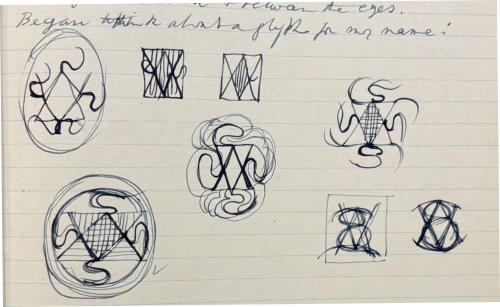
Following Grant’s advice, Colquhoun began to think about constructing a glyph, or yantra of her name, but she
found the process puzzling, She understood its purpose - the by-passing of the intellect so that the intuition
may function better - but had no clear idea of what it was supposed to look like. Following advice, she began to
make tentative sketches, which she recorded in her magical diary (2 June 1952):
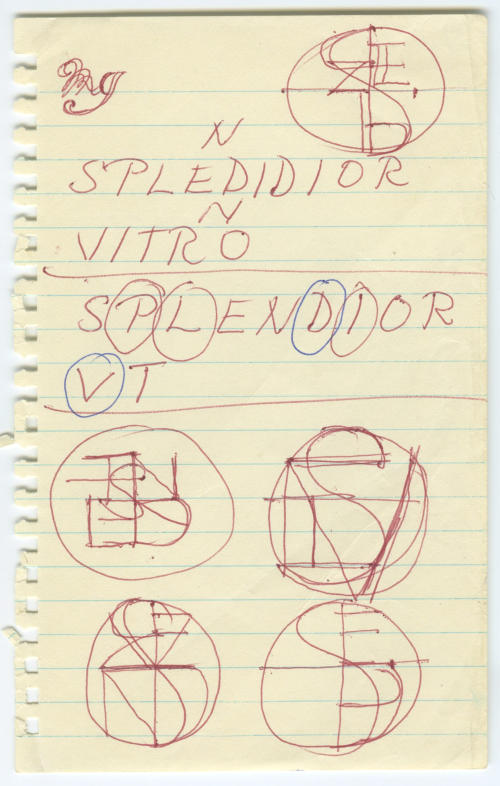
Colquhoun sent a version to Grant, who did not approve. He was critical of the fact that she had only used the
letters “S” and “V”, pointing out that each letter in the motto contained its own current of force and should be
included, although it need be used only once. The process of sigilisation advocated by Grant involved the
superimposing and conjoining of the letters of a name (or of a magical desire), into a single glyph, having
deleted any repetitions. It was adopted from the method described by Austin Spare, whose first sigils of this
nature appeared in his Book of Satyrs (1907).
When choosing her motto Colquhoun did not realise that each letter represented a force but, newly
enlightened, she continued to experiment:
Eventually, she settled on a design which she submitted to Grant. Sadly, his reaction is not known as there is a
gap in the correspondence. I am constrained from reproducing the final glyph, which has never been published
and which, for some reason, Colquhoun herself never referred to in her published or unpublished writings and
never seems to have used.
The monogram
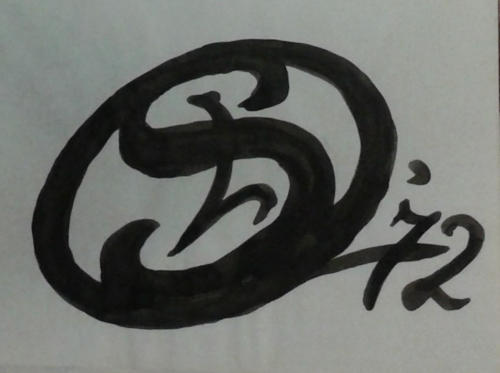
The existence of the sigil is unknown outside of the correspondence with Kenneth Grant but, very publicly, in
1962 Colquhoun began to sign her art works with a monogram rather than her full surname. The monogram is
formed from the initials not of her birth name but of her magical name and comprises the letters S and V
contained within an oval, followed by an abbreviated date. The purpose of a sigil, as described by Grant, is to
remove all literary and verbal meaning from the letters so that the resulting symbol speaks directly to the
unconscious. The monogram, however, has the forms of the letters, and the date, completely undisguised: its
meaning is clear. It appeals directly to rational mentation, so its purpose must be rather different. Colquhoun
herself is known to have referred to the monogram not as a “sigil”, but as a “device”. It was not designed to be
the focus of meditation, but as an identifier.
Curiously, the final works Colquhoun is known to have completed, two small collages made whilst she was a
resident in a care home, are not monogrammed, but initialled ‘IC’ and dated 1987. One wonders why.
text updated June 2026